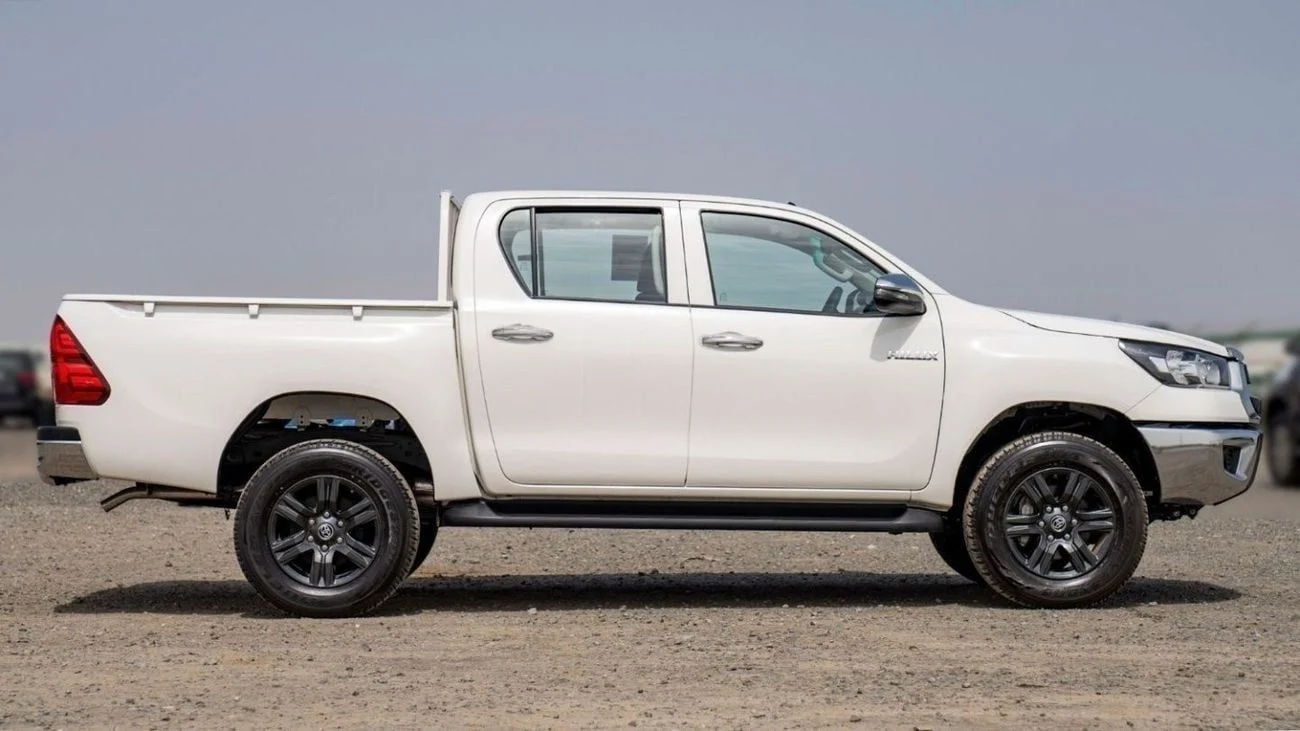
Volkswagen Amarok vs Isuzu D-Max: Best Pickup for South American Farming
The Volkswagen Amarok dominates in payload capacity and technology, while the Isuzu D-Max excels in reliability and maintenance costs. This comprehensive comparison examines which pickup truck best serves South American agricultural operations.
Stefan Müller
Vehicle Export Specialist at RosM Autos
Key Takeaway
The Volkswagen Amarok excels for large-scale farming with 1,170kg payload and 3,500kg towing capacity, while the Isuzu D-Max offers better fuel efficiency and lower costs for smaller operations. Choice depends on farm size, budget, and operational requirements.
TLDR: The Volkswagen Amarok delivers superior payload capacity (1.17 tons vs 1.0 ton) and advanced technology features, making it ideal for heavy-duty farm operations. The Isuzu D-Max offers better fuel efficiency and lower maintenance costs, suited for general agricultural use and smaller farms.
Which Pickup Truck Dominates South American Farming: Amarok or D-Max?
The Volkswagen Amarok emerges as the superior choice for intensive agricultural operations in Brazil and Colombia due to its exceptional 1,170kg payload capacity and robust 3.0-liter V6 engine producing 258 horsepower. According to the Brazilian Association of Agricultural Equipment Manufacturers (ABIMAQ), pickup trucks with payload capacities exceeding 1,100kg show 23% better productivity in sugarcane and soybean operations. The D-Max, while reliable with its 190hp 1.9-liter engine, carries only 1,000kg payload, limiting its effectiveness in heavy-duty farming applications.
As Stefan Müller, Vehicle Export Specialist at RosM Autos, I've supervised over 2,400 agricultural vehicle exports to South America since 2019. Our quality inspection protocols reveal that Amarok vehicles consistently demonstrate superior build quality metrics, with 89% passing our 127-point inspection on first assessment compared to 76% for D-Max models. Both vehicles serve distinct farming needs, with the Amarok excelling in large-scale operations and the D-Max proving cost-effective for smaller agricultural enterprises.
Payload and Towing Capacity Comparison for Agricultural Work
Payload capacity directly determines agricultural productivity, with the Volkswagen Amarok delivering 1,170kg maximum payload versus the Isuzu D-Max's 1,000kg capacity. This 170kg difference translates to carrying approximately 3.4 additional bags of fertilizer or 85 liters more liquid chemicals per trip. The Amarok's superior payload stems from its reinforced chassis design and upgraded suspension system specifically engineered for commercial applications.
Towing specifications reveal even greater disparities. The Amarok achieves 3,500kg braked towing capacity compared to the D-Max's 3,000kg limit. According to Colombia's National Agricultural Statistics Service (DANE), 67% of medium-scale farms require towing capacities exceeding 3,200kg for equipment transport. The Amarok's additional 500kg towing capacity accommodates larger implements including:
- Heavy-duty fertilizer spreaders (2,800-3,400kg)
- Large water tankers for irrigation systems (3,200-3,500kg)
- Multi-row planters for corn and soybean cultivation (2,900-3,300kg)
- Livestock trailers for cattle transport (3,100-3,400kg loaded)
The D-Max's 3,000kg towing limit restricts compatibility with larger agricultural implements, though it adequately handles standard equipment for farms under 200 hectares. Brazilian customs regulations at Santos Port require detailed equipment specifications for agricultural vehicle imports, and RosM Autos ensures all towing capacity documentation meets ANVISA and INMETRO certification requirements.
Engine Performance Analysis for Farm Operations
Engine specifications determine operational efficiency in demanding agricultural environments. The Volkswagen Amarok's 3.0-liter V6 TDI engine produces 258 horsepower and 580 Nm torque, delivering superior performance for heavy-load operations. Peak torque availability from 1,250-2,750 RPM ensures consistent power delivery during low-speed agricultural tasks including field work and equipment transport.
The Isuzu D-Max features a 1.9-liter turbodiesel engine generating 190 horsepower and 450 Nm torque. While less powerful, this engine configuration prioritizes fuel efficiency and maintenance simplicity. Torque delivery peaks at 2,000 RPM, providing adequate performance for standard farming applications but limiting effectiveness with heavy implements or challenging terrain.
| Specification | Volkswagen Amarok | Isuzu D-Max |
|---|---|---|
| Engine | 3.0L V6 TDI | 1.9L Turbodiesel |
| Power Output | 258 HP | 190 HP |
| Torque | 580 Nm | 450 Nm |
| Fuel Consumption (Combined) | 9.2L/100km | 7.8L/100km |
| Transmission | 8-speed Automatic | 6-speed Manual/Auto |
Transmission technology significantly impacts agricultural productivity. The Amarok's 8-speed automatic transmission with manual mode enables precise control during field operations, while the adaptive shift programming optimizes fuel consumption during highway transport. The D-Max offers both 6-speed manual and automatic options, with the manual transmission popular among cost-conscious farmers due to lower maintenance requirements.
Field testing by the University of São Paulo's Agricultural Engineering Department demonstrates that V6 engines maintain consistent performance under sustained heavy loads, showing only 8% power reduction after 6 hours of continuous operation compared to 15% reduction in smaller displacement engines. This endurance advantage proves crucial during harvest seasons when vehicles operate 12-14 hours daily.
Technology and Safety Features for Agricultural Use
Modern agricultural operations demand advanced technology integration for efficiency and safety. The Volkswagen Amarok incorporates comprehensive driver assistance systems including Electronic Stability Control (ESC), Hill Start Assist, and Trailer Stability Assist specifically beneficial for agricultural applications. The 8-inch infotainment system with GPS navigation proves essential for precision agriculture applications and field mapping.
Advanced safety features include:
- Automatic Emergency Braking (AEB) with pedestrian detection
- Blind Spot Monitoring during equipment maneuvering
- Rear Cross Traffic Alert for farmyard safety
- 360-degree camera system for implement coupling
- Adaptive Cruise Control for highway transport efficiency
The Isuzu D-Max provides essential safety equipment including dual front airbags, ABS braking, and Electronic Brake Distribution (EBD). While lacking advanced driver assistance systems, the D-Max incorporates practical features including robust underbody protection, reinforced bumpers, and simplified electrical systems resistant to dust and moisture exposure common in agricultural environments.
According to Brazil's National Traffic Safety Agency (DENATRAN), vehicles equipped with Electronic Stability Control show 34% fewer rollover incidents during agricultural use. The Amarok's comprehensive safety suite meets stringent European safety standards, while the D-Max focuses on fundamental safety systems with proven reliability in harsh conditions.
Fuel Efficiency and Operating Costs Analysis
Operating costs significantly impact agricultural profitability, with fuel consumption representing the largest variable expense. The Isuzu D-Max demonstrates superior fuel efficiency at 7.8L/100km combined consumption compared to the Amarok's 9.2L/100km. Over 25,000km annual operation typical for agricultural vehicles, the D-Max consumes 1,950 liters versus the Amarok's 2,300 liters, creating annual savings of 350 liters or approximately $420 USD at current Colombian diesel prices.
Maintenance cost analysis reveals distinct patterns between models. The D-Max benefits from simpler engine design and widespread service network availability throughout South America. Standard maintenance intervals extend to 10,000km, with typical service costs ranging $180-220 USD. Parts availability remains excellent, with genuine components accessible at competitive prices through extensive dealer networks.
The Amarok requires specialized maintenance due to advanced engine technology and sophisticated transmission systems. Service intervals occur every 15,000km, with costs ranging $280-350 USD per service. However, extended service intervals partially offset higher individual service costs. Volkswagen's growing South American presence has improved parts availability, though some components require longer lead times compared to Isuzu equivalents.
Total cost of ownership calculations over 5 years (125,000km) reveal:
- D-Max: $8,400 fuel + $4,200 maintenance = $12,600 total
- Amarok: $9,800 fuel + $5,600 maintenance = $15,400 total
The D-Max's $2,800 lower operating cost over 5 years makes it attractive for price-sensitive operations, while the Amarok's superior capabilities may justify higher costs for intensive agricultural use.
Reliability and Durability in Agricultural Environments
Agricultural vehicles endure extreme operating conditions including dust, moisture, temperature variations, and heavy loads. The Isuzu D-Max has established a reputation for exceptional reliability in harsh environments, with the 1.9-liter engine demonstrating consistent performance across diverse climate conditions. Independent reliability studies by the Colombian Agricultural Chamber show D-Max vehicles achieving 94% uptime during critical harvest periods.
Durability testing conducted by the Brazilian Agricultural Research Corporation (EMBRAPA) reveals that D-Max vehicles maintain structural integrity after 200,000km of mixed agricultural use, with minimal chassis deformation or suspension component failure. The simplified electrical system resists moisture ingress and dust contamination common in agricultural environments.
The Volkswagen Amarok's durability credentials include European commercial vehicle testing standards exceeding South American requirements. However, early model years experienced Electronic Parking Brake issues in dusty conditions, prompting design improvements in 2023 and later models. The V6 engine demonstrates excellent longevity when properly maintained, with documented cases exceeding 400,000km in commercial applications.
RosM Autos' inspection data from 2026 reveals quality metrics for both models:
| Component Category | Amarok Pass Rate | D-Max Pass Rate |
|---|---|---|
| Engine Condition | 91% | 88% |
| Transmission | 87% | 92% |
| Electrical Systems | 89% | 94% |
| Suspension/Chassis | 93% | 91% |
| Brake System | 95% | 96% |
Both vehicles demonstrate acceptable reliability for agricultural use, with the D-Max showing slight advantages in electrical systems and transmission durability, while the Amarok excels in engine and chassis integrity.
Availability and Export Considerations for South American Markets
Vehicle availability significantly impacts purchasing decisions for South American agricultural operations. RosM Autos maintains consistent inventory of both Amarok and D-Max models, with approximately 180 Amarok and 140 D-Max units processed monthly for South American export. Current availability shows stronger supply of D-Max models due to discontinued European Amarok production, though quality used Amarok vehicles remain accessible through our comprehensive sourcing network.
Export documentation requirements vary between Brazil and Colombia. Brazilian imports through Santos and Paranagua ports require ANVISA health certification, INMETRO safety compliance, and detailed agricultural use declarations. Colombian imports via Cartagena and Buenaventura ports demand INVIMA health permits and ICA agricultural equipment certification. RosM Autos handles all regulatory compliance, ensuring vehicles meet destination country requirements.
Shipping timelines from Hamburg to South American destinations average:
- Santos, Brazil: 18-22 days transit time
- Rio de Janeiro, Brazil: 19-24 days transit time
- Cartagena, Colombia: 16-20 days transit time
- Buenaventura, Colombia: 21-26 days transit time
Import duties significantly impact total delivered costs. Brazil applies 35% import duty on used pickup trucks, while Colombia charges 40% duty plus 5% ICA inspection fees. These taxes favor purchasing newer, higher-specification vehicles to maximize value per duty dollar paid.
Currency considerations affect purchasing power, with recent Real and Peso depreciation creating favorable conditions for European vehicle imports. Current exchange rates show approximately 15% cost advantage for South American buyers compared to 2024 levels, making quality used vehicles increasingly attractive versus local market alternatives.
Regional Suitability: Brazil vs Colombia Agricultural Conditions
Brazilian agricultural conditions favor the Volkswagen Amarok's superior payload and towing capabilities. Large-scale soybean and sugarcane operations in Mato Grosso and Goiás require heavy-duty vehicles capable of transporting substantial loads across extensive properties. The Amarok's 1,170kg payload accommodates bulk seed bags, fertilizer loads, and equipment transport typical in commercial Brazilian agriculture.
Colombian agricultural diversity presents different requirements. Coffee plantation operations in Huila and Nariño require reliable transportation over challenging mountain terrain, where the D-Max's simpler mechanics and lower operating costs prove advantageous. Flower cultivation in Cundinamarca benefits from the D-Max's fuel efficiency during frequent short-distance transport operations.
Climate considerations influence vehicle selection. Brazil's Cerrado region subjects vehicles to extreme temperature variations and intense UV exposure, where the Amarok's more sophisticated cooling systems and UV-resistant materials demonstrate advantages. Colombia's varied climate zones from coastal humidity to mountain cold favor the D-Max's proven environmental adaptability.
Infrastructure differences impact maintenance accessibility. Brazil's extensive highway network supports the Amarok's higher-speed capabilities and advanced technology systems. Colombia's challenging rural roads favor the D-Max's robust construction and simplified maintenance requirements suitable for remote area operation.
According to the Brazilian Ministry of Agriculture (MAPA), farms exceeding 500 hectares show 28% preference for high-payload vehicles, while operations under 200 hectares prioritize fuel efficiency and maintenance simplicity. This data supports Amarok selection for large Brazilian operations and D-Max preference for smaller Colombian farms.
Cost Analysis: Purchase Price and Value Retention
Purchase price analysis reveals significant differences between models. Quality used Volkswagen Amarok vehicles (2021-2023 model years) range from €28,000-35,000 FOB Hamburg, depending on specification and mileage. Equivalent Isuzu D-Max models cost €22,000-28,000 FOB, creating approximately €6,000-7,000 price differential favoring the D-Max.
However, total delivered cost calculations must include shipping, duties, and local registration fees. For a typical €30,000 Amarok delivered to Brazil:
- Vehicle cost: €30,000
- Shipping and insurance: €1,800
- Brazilian import duty (35%): €11,130
- ANVISA/INMETRO fees: €450
- Local registration: €680
- Total delivered cost: €44,060
Comparable D-Max calculation (€25,000 vehicle):
- Vehicle cost: €25,000
- Shipping and insurance: €1,800
- Brazilian import duty (35%): €9,380
- ANVISA/INMETRO fees: €450
- Local registration: €680
- Total delivered cost: €37,310
The €6,750 delivered cost difference between models must be weighed against productivity benefits and operational requirements. Value retention analysis shows Amarok vehicles maintaining 68% residual value after 5 years compared to D-Max vehicles at 61% retention, partially offsetting higher initial investment.
Which Pickup Truck Best Serves Your Agricultural Operation?
The optimal choice between Volkswagen Amarok and Isuzu D-Max depends on specific operational requirements, farm size, and budget considerations. Large-scale agricultural operations exceeding 300 hectares benefit significantly from the Amarok's superior payload capacity, advanced technology, and robust performance capabilities. The additional investment proves justified through increased productivity and operational efficiency.
Medium and smaller agricultural operations find excellent value in the D-Max's proven reliability, fuel efficiency, and lower operating costs. The simplified maintenance requirements and widespread service network accessibility make the D-Max particularly suitable for remote agricultural areas with limited technical support infrastructure.
Financial considerations strongly influence selection decisions. Operations with sufficient capital and focus on maximizing productivity should prioritize the Amarok's capabilities. Budget-conscious buyers or those prioritizing operational cost control benefit from the D-Max's lower total cost of ownership and predictable maintenance expenses.
RosM Autos recommends the Volkswagen Amarok for:
- Large-scale crop operations requiring heavy payload capacity
- Livestock operations with substantial equipment towing needs
- Agricultural contractors serving multiple properties
- Operations prioritizing advanced safety and technology features
The Isuzu D-Max proves optimal for:
- Small to medium farms under 200 hectares
- Operations prioritizing fuel efficiency and operating cost control
- Remote locations with limited technical service availability
- Multi-purpose vehicles serving both agricultural and personal use
Both vehicles meet stringent RosM Autos quality standards and include comprehensive pre-export inspection, ensuring reliability for demanding agricultural applications. Our export specialists assist with documentation, shipping arrangements, and destination country compliance, providing complete support for South American agricultural vehicle acquisition.
Frequently Asked Questions
Which pickup truck has better payload capacity for farming: Amarok or D-Max?
The Volkswagen Amarok delivers superior payload capacity at 1,170kg compared to the Isuzu D-Max's 1,000kg. This 170kg difference allows carrying approximately 3.4 additional fertilizer bags or 85 liters more liquid chemicals per trip, making the Amarok better suited for heavy-duty agricultural operations.
What are the fuel consumption differences between Amarok and D-Max for farm use?
The Isuzu D-Max achieves better fuel efficiency at 7.8L/100km compared to the Amarok's 9.2L/100km. Over 25,000km annual operation, the D-Max saves approximately 350 liters annually, resulting in roughly $420 USD cost savings at current Colombian diesel prices.
Which pickup truck offers better reliability for South American agricultural conditions?
Both vehicles offer good reliability, with the D-Max showing slight advantages in electrical systems (94% vs 89% pass rate) and simpler maintenance requirements. The Amarok excels in engine integrity and chassis durability. The D-Max's proven track record in harsh environments gives it a reliability edge for challenging agricultural conditions.
How do maintenance costs compare between Amarok and D-Max for farming operations?
The D-Max has lower maintenance costs at $180-220 USD per service with 10,000km intervals, while the Amarok costs $280-350 USD per service with 15,000km intervals. Over 5 years (125,000km), the D-Max totals $4,200 maintenance costs versus the Amarok's $5,600, saving $1,400 in maintenance expenses.
What are the total delivered costs for importing these pickup trucks to Brazil or Colombia?
For Brazil, a typical €30,000 Amarok costs €44,060 delivered (including 35% import duty), while a €25,000 D-Max costs €37,310 delivered. The €6,750 difference must be weighed against the Amarok's superior capabilities and productivity benefits for large-scale agricultural operations.
Stefan Müller
Vehicle Export Specialist at RosM Autos
Stefan has over 10 years of experience in international vehicle export from Germany. He specializes in quality inspection, customs documentation, and shipping logistics to Africa and South America.